


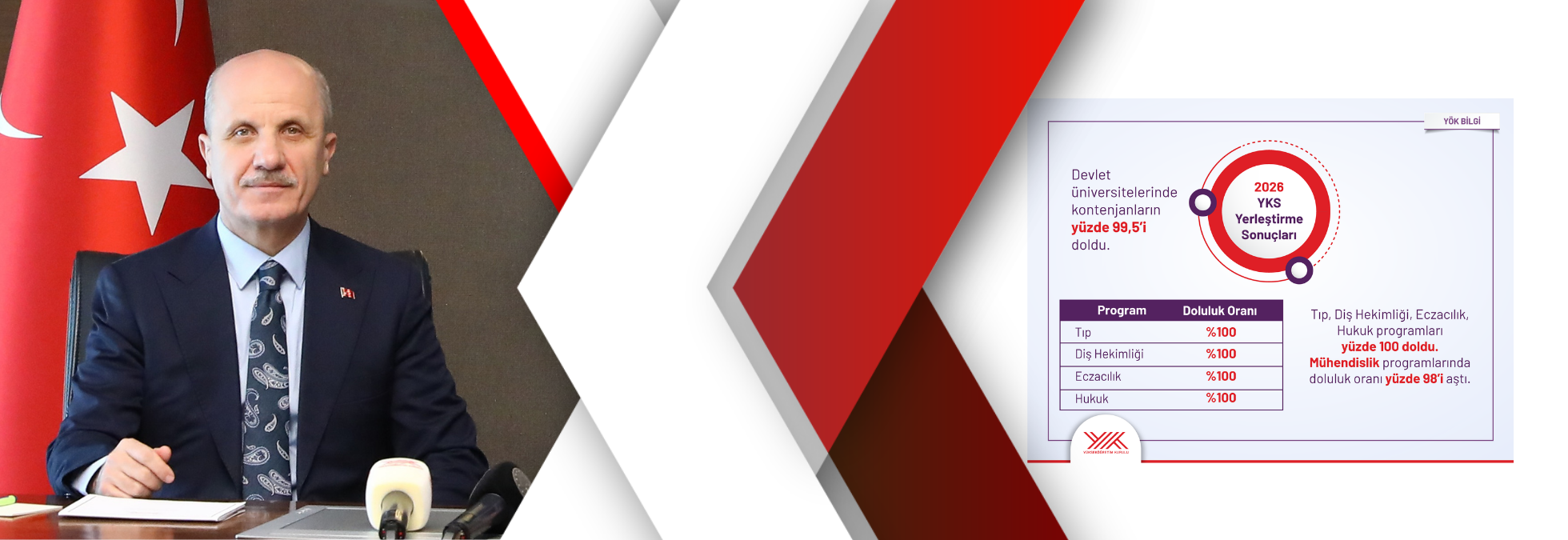
2026-YKS Placement Results Announced
- CoHE’s sound quota policy pays off: Historic occupancy at public universities
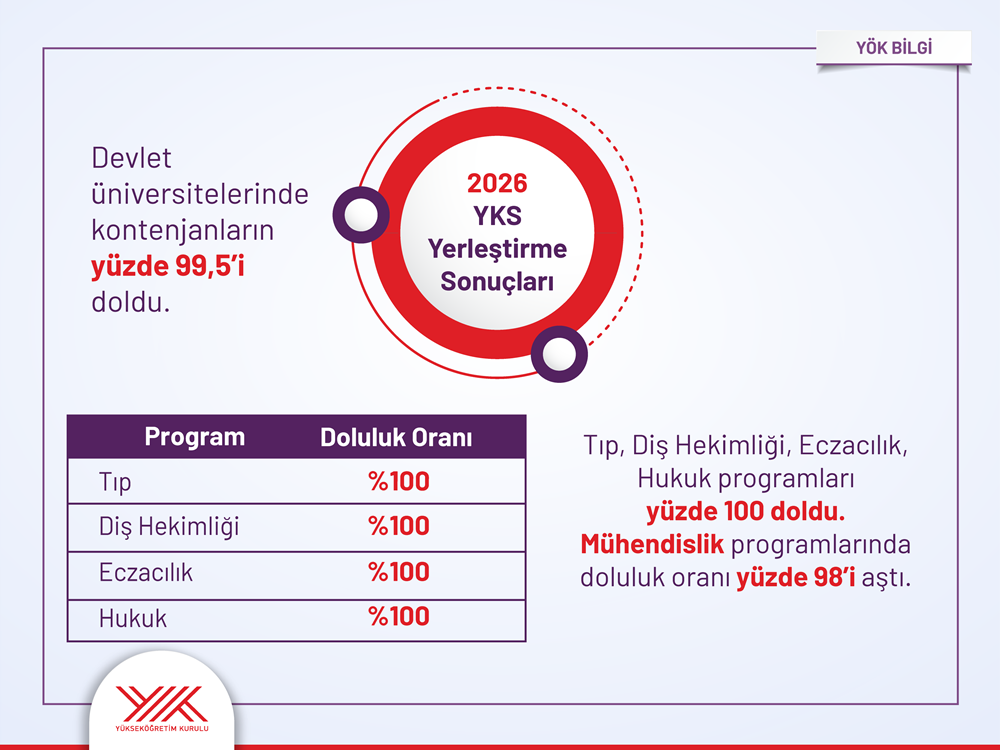
- 479,000 of 481,000 places at public universities filled, bringing the occupancy rate to 99.5 percent
- Medicine, law, dentistry and pharmacy programs subject to success-ranking thresholds reached 100 percent occupancy, while engineering programs exceeded 98 percent
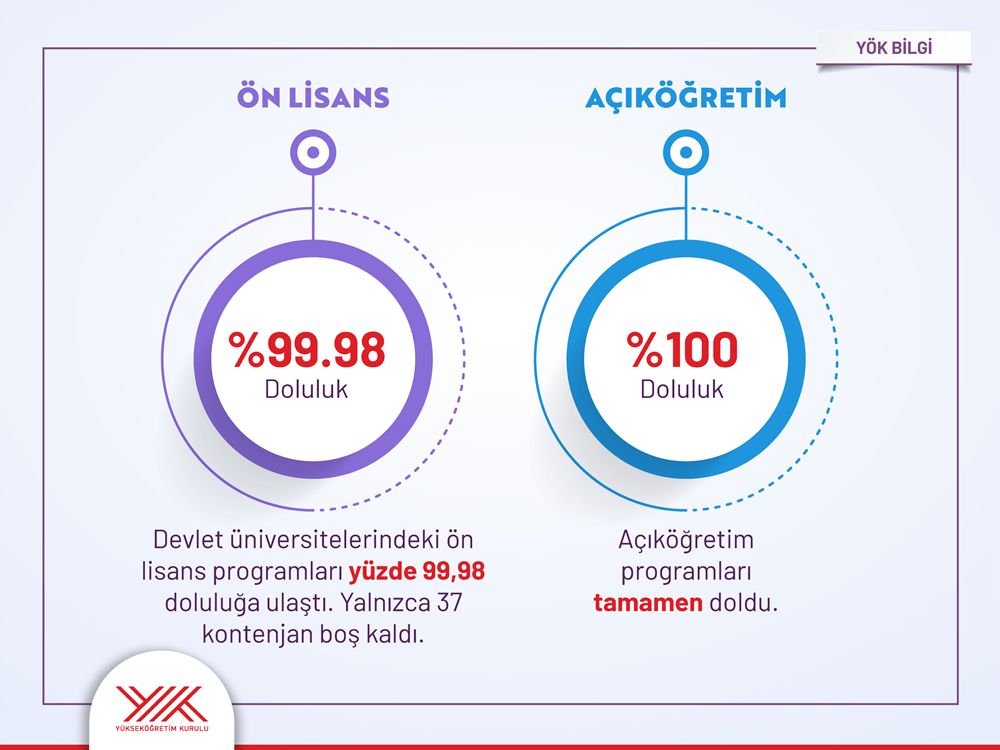
- Only 37 places remained vacant in associate degree programs
- Strong interest in the careers of the future, from AI to cybersecurity: Newly introduced programs attract high demand
- CoHE President Özvar: “The soundness of our quota policy is reflected in the results”
“Our goal is to train the qualified human resources that will make Türkiye one of the countries that develops, produces and leads in artificial intelligence and advanced technologies”
August 18, 2026
The 2026 Higher Education Institutions Examination (2026-YKS) placement results have been announced. The results demonstrate that the quota policy implemented by the Council of Higher Education (CoHE), with due consideration for the balance between supply and demand in higher education, has produced strong results. Public universities reached a historic occupancy rate of 99.5 percent.
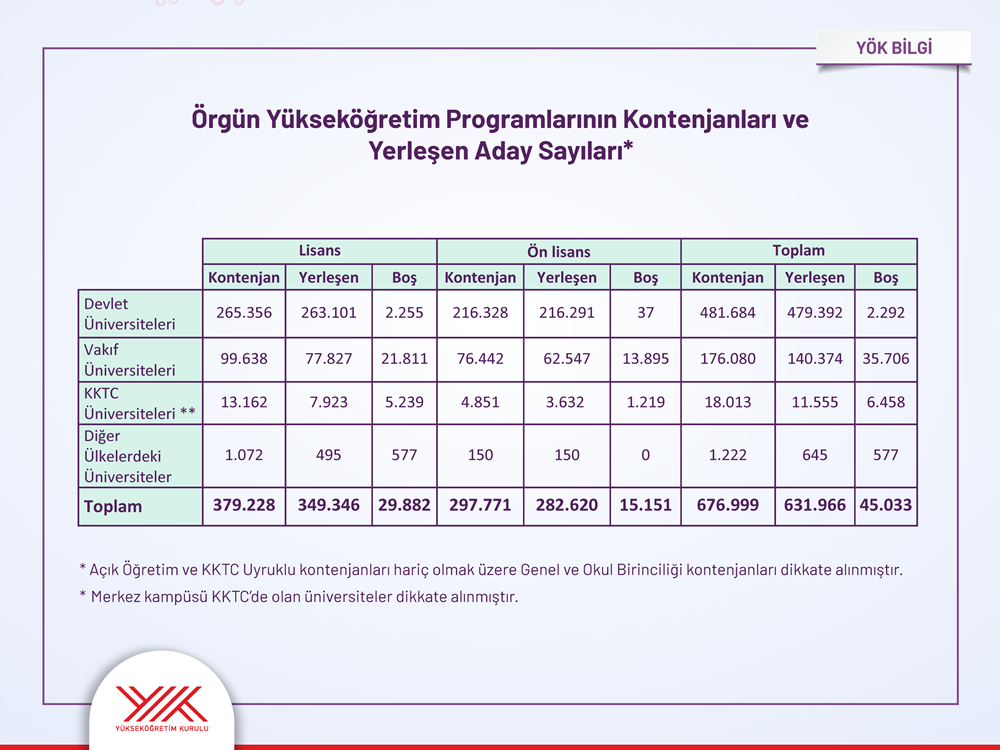
A total of 479,392 of the 481,684 places available in on-campus programs at public universities were filled, leaving only 2,292 places vacant. The number of vacant places fell by 58.3 percent from 5,503 last year.
The occupancy rate for undergraduate programs at public universities stood at 99.15 percent, while the rate for associate degree programs reached 99.98 percent, bringing the overall occupancy rate to 99.52 percent. Only 37 places remained vacant in associate degree programs. The record occupancy rate in associate degree programs demonstrates young people’s strong interest in vocational and technical higher education.
All general quota places at public universities’ domestic campuses in medicine, dentistry, pharmacy and law programs subject to success-ranking thresholds were filled. Occupancy in engineering programs exceeded 98 percent, while no vacancies remained in the general quota places at public universities in mathematics, physics, chemistry, biology, history, geography, business administration and economics programs.
The occupancy rate for general quota places at foundation higher education institutions stood at 79.7 percent.
- No Vacancies in Careers-of-the-Future Programs
The programs introduced by CoHE with a focus on the careers of the future, particularly artificial intelligence, data science, cybersecurity and digital transformation, attracted strong interest from students.
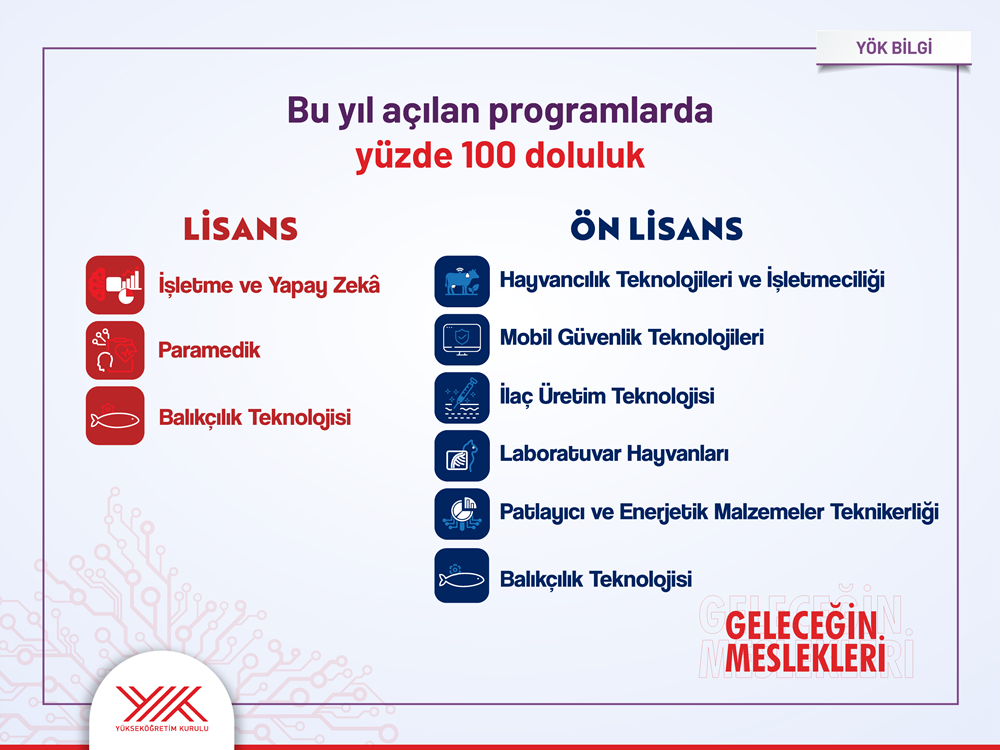
All places in the programs introduced for the first time this year—Business Administration and Artificial Intelligence, Paramedic Studies, Livestock Technologies and Management, Pharmaceutical Manufacturing Technology, Laboratory Animals, Mobile Security Technologies, Explosives and Energetic Materials Technology, and Fisheries Technology—were filled.
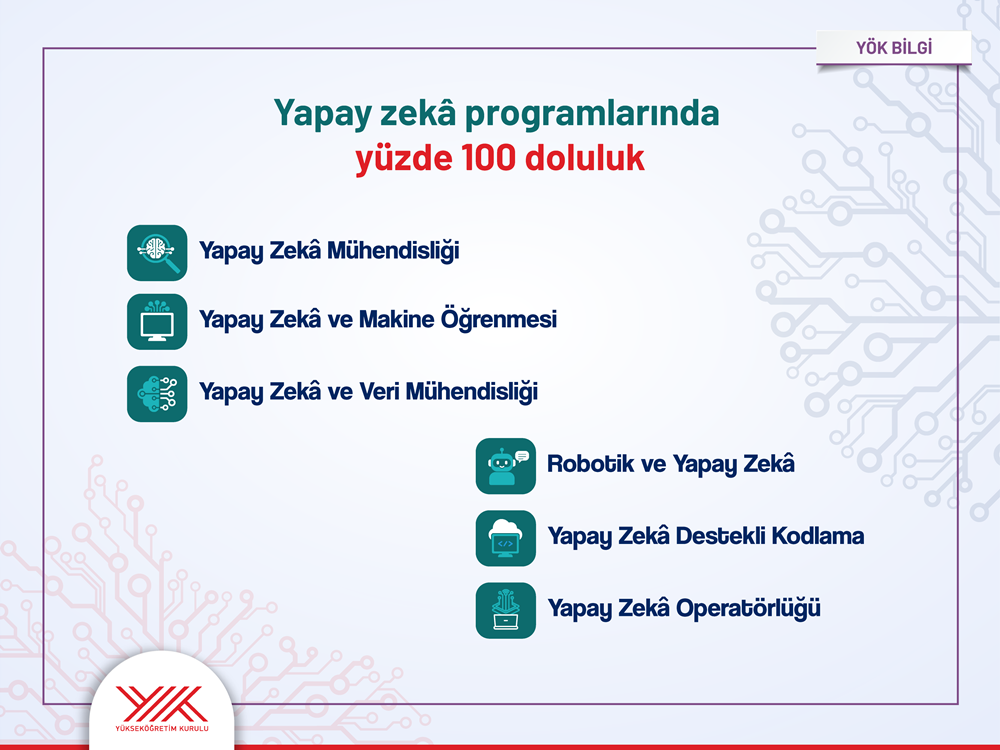
AI-based undergraduate and associate degree programs also reached 100 percent occupancy. Not a single place remained vacant in Artificial Intelligence Engineering, Artificial Intelligence and Machine Learning, Artificial Intelligence and Data Engineering, Robotics and Artificial Intelligence, AI-Assisted Coding, and Artificial Intelligence Operations programs.
A significant proportion of teacher education programs at public universities also filled all available places.
German, Geography, French, Japanese, Mathematics, Early Childhood Education, Special Education, Guidance and Psychological Counseling, Primary School Teaching, Social Studies, History, Turkish Language and Literature, and Turkish Language Teaching programs all reached 100 percent occupancy.
- Quotas Filled in Open and Distance Education
All 89,396 places allocated to open education programs at public universities were filled. The 8,298 places available in distance education programs were also fully filled.
The occupancy rate for the 1,210 places allocated to distance education programs at foundation universities was 97.2 percent. The occupancy rate for programs both subject to and not subject to success-ranking thresholds was 79 percent.
- 1.279 Million Candidates Made Preferences
Of the 2,255,076 candidates who took the 2026-YKS, placement scores were calculated for 2,187,747 candidates. Of these, 1,279,439 submitted preferences.
This year, there were around 807,000 places in total, including quotas allocated for the Special Talent Examination (ÖZYES) and candidates holding the citizenship of the Turkish Republic of Northern Cyprus (TRNC). Excluding the places allocated to ÖZYES and TRNC citizens, candidates made preferences for 766,000 places.
Taking on-campus, open and distance education programs as a whole, 730,854 of the candidates who submitted preferences earned the right to enroll in a higher education institution.
The number of candidates placed in on-campus associate degree and undergraduate programs at public and foundation universities in Türkiye was 619,766.
- Four in Every 10 Candidates Placed in One of Their Top Three Choices
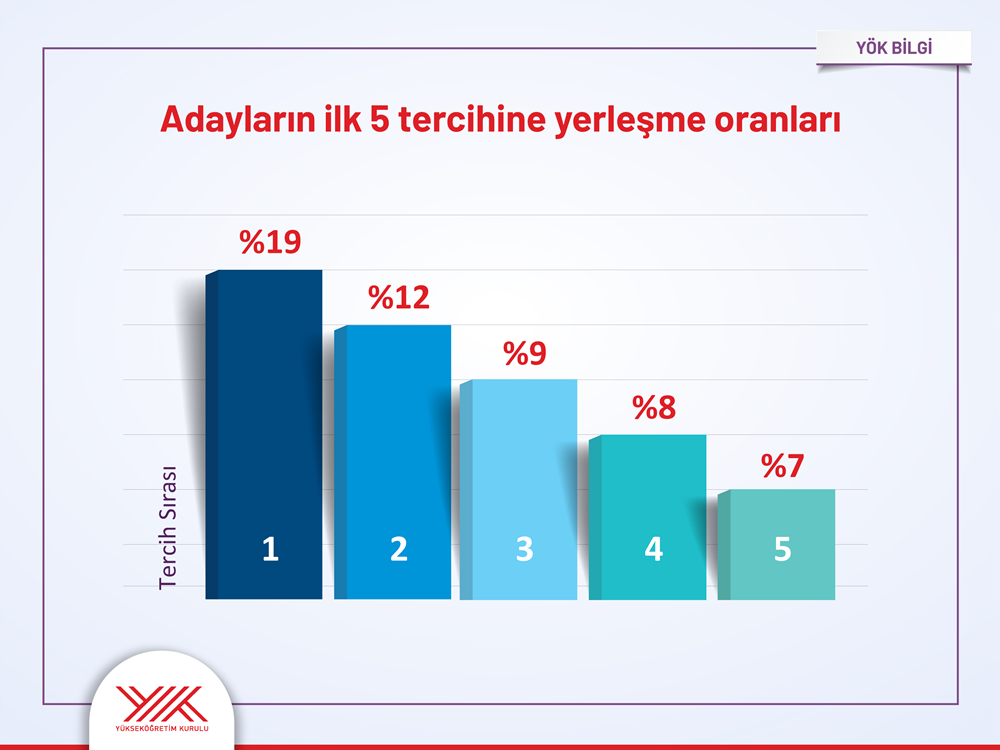
According to the placement results, 19 percent of candidates were placed in their first choice, 12 percent in their second choice and 9 percent in their third choice. Thus, 40 percent of candidates secured one of their top three choices.
The share of candidates placed in their fourth choice was 8 percent, while 7 percent were placed in their fifth choice. As a result, 55 percent of candidates were placed in one of their top five choices.
Among all candidates eligible to submit preferences, 41.5 percent did not submit any preferences despite being entitled to do so. The corresponding figure was 45.7 percent among final-year students.
Among candidates who had previously graduated from secondary education but had not been placed in any higher education program, 70 percent submitted preferences.
Özvar: “Our Quota Policy Had a Positive Impact on the Placement Results”
Commenting on the 2026-YKS placement results, CoHE President Erol Özvar said, “Under the leadership of President Recep Tayyip Erdoğan, we have carried out a major transformation that has not only expanded access to higher education but also raised quality and prepared our young people for Türkiye’s future.”
Özvar said the results demonstrated the soundness of the quota policy implemented with consideration for the balance between supply and demand.
Noting that quotas had been revised in a number of programs, particularly law, pharmacy, dentistry, psychology and teacher education, Özvar said, “We are very pleased that our quota policy has had a positive impact on the placement results. Occupancy at our public universities has reached a historic level, with virtually no places left vacant. The fact that medicine, dentistry, pharmacy and law programs subject to success-ranking thresholds achieved 100 percent occupancy also clearly demonstrates the soundness of this policy.”
“Our Young People Are Aware of the Careers of the Future”
Emphasizing the significance of the strong demand for programs in artificial intelligence, data science, cybersecurity and digital technologies, Özvar noted that students’ preferences align with the human resources Türkiye will need in the future.
Özvar said, “This picture demonstrates not only our students’ high level of awareness of the careers of the future, but also that our higher education policies are progressing in line with our country’s human resource needs. Our goal is to train the qualified human resources that will make Türkiye one of the countries that develops, produces and leads in artificial intelligence and advanced technologies.”
- Notable Rise in Success Rankings
CoHE President Özvar also drew attention to the rise in the success rankings of students placed in programs at public universities.
Noting that the success rankings for some programs had risen into the top few thousand, Özvar said, “Students with significantly higher success rankings are now being placed in the programs of our long-established public universities. The fact that rankings in some programs have risen into the top few thousand is a clear indication of the strong demand for and confidence in these universities.”
Özvar expressed his belief that the combination of students’ academic achievement and the expertise of academics would result in an even stronger higher education landscape in the period ahead.
“Candidates Who Were Not Placed Should Also Follow the Additional Placement Process”
Congratulating candidates who were placed in a higher education program and their families, Özvar also urged candidates who were not placed in any program in the initial placement round to follow the additional placement process.
“I wholeheartedly congratulate all our candidates who have been placed in a higher education program, as well as their valued families who have supported them throughout this process. I wish our young people a successful and productive university life,” Özvar said, calling on candidates who were not placed to “carefully follow the additional placement process without losing hope.”
Özvar stated that CoHE would notify the Student Selection and Placement Center (ÖSYM) of the vacant places at universities and noted that ÖSYM would announce the additional placement schedule.
Images
Images